Appearance
Change sets: handing work to an agent
An agent that reads the live model is aiming at a moving target: someone renames a container while it works, and half its assumptions quietly expire. A change set is a piece of work written against a pinned version — one that cannot move while the work is being done.
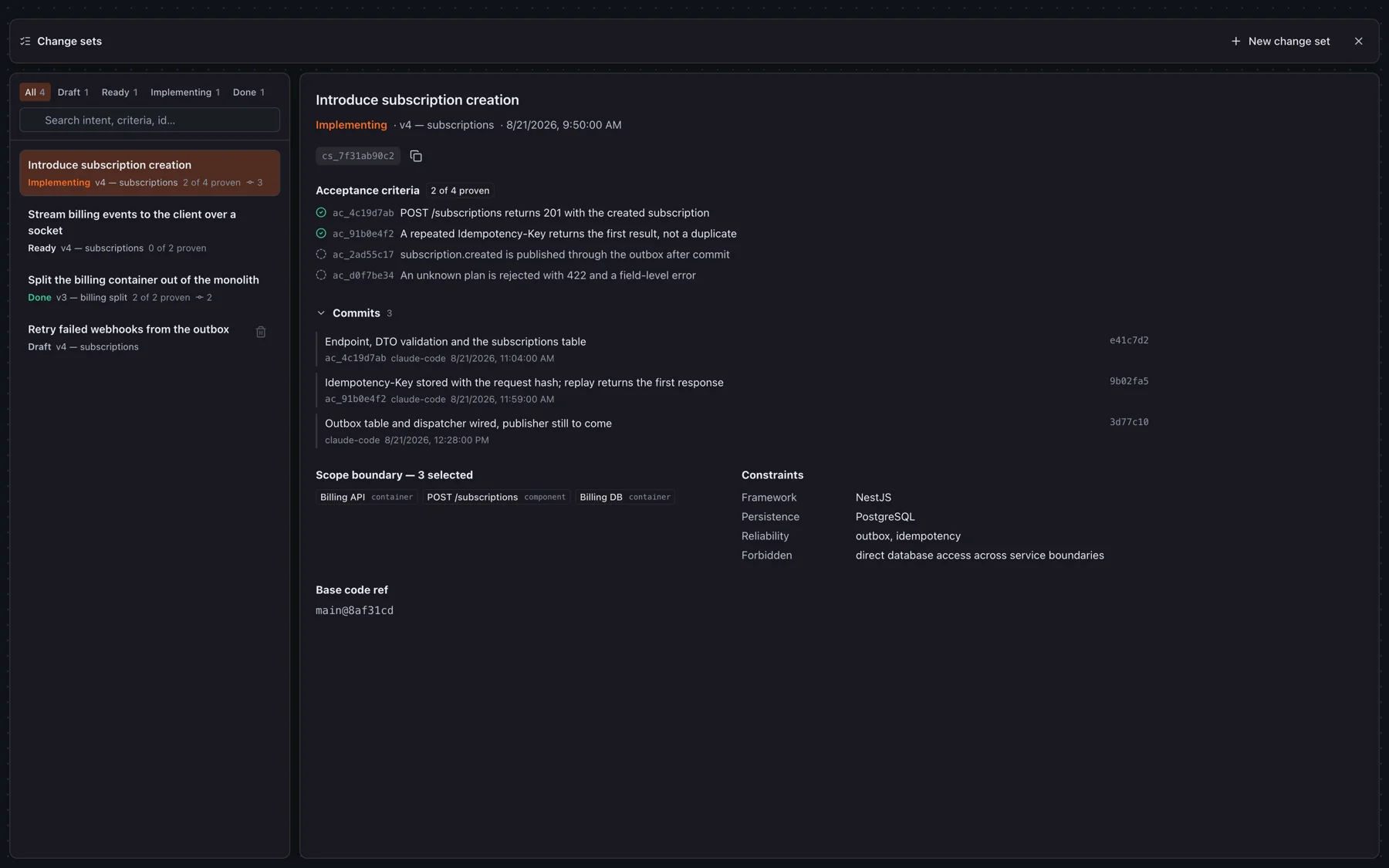
What a change set holds
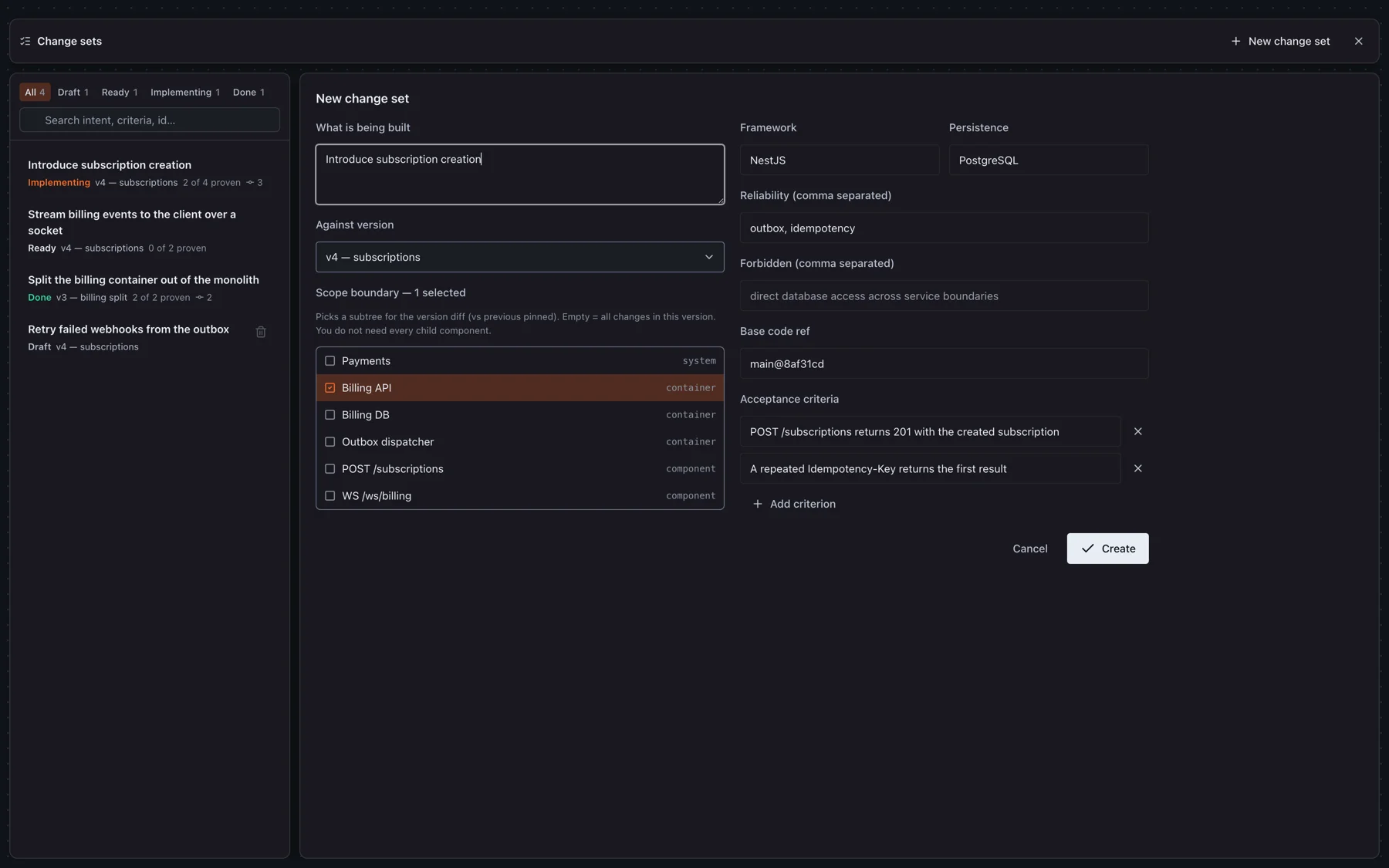
- Intent — one sentence: what is being built.
- Version — the pinned revision the work stands on. Everything the agent reads comes from it.
- Scope — the elements this work may touch. The picker offers what actually changed in that version compared to the previous pinned one, plus their parents, so a system can cover its children without listing each of them.
- Constraints — framework, persistence, reliability patterns, and what is forbidden. Decisions already made, so the agent does not re-make them.
- Acceptance criteria — each gets an
ac_…id that a test name cites. This is what makes “done” a fact rather than a claim. - Base code ref — the commit the implementation starts from, when you know it.
1. Pin a version, then write the change set
Cut a version from the rail at the bottom-left of the canvas — a change set can only stand on a pinned one, because an automatic snapshot may be evicted and take the work with it. A version identical to the previous one is refused: there is nothing in it to implement.
Then open Instruments → Change sets (or the same entry from the version rail) and press New change set. The catalog lists everything the project has, filtered by status.
2. Hand it over
Open the change set and press Copy agent handoff. You get a prompt with both ids already in it — paste it into Cursor, Claude Code, or anything else wired to the MCP server. It tells the agent to:
- mark the work started, then fetch
c4_get_implementation_bundle— a scoped diff of that revision against the previous pinned version, with the contracts, neighbours, flows and documentation of the elements in scope, and nothing else from the graph; - treat the bundle as the specification — if something in it is wrong or missing, say so rather than editing the model mid-flight;
- write a test per criterion with its
ac_…id in the test name; - call
c4_report_progressafter each finished piece, with the summary, the criterion it proves and the commit sha.
Endpoints arrive with their protocol spelled out, so an agent knows whether it is implementing a request/response call or a channel:
json
"contract": {
  "protocol": "websocket",
  "method": "WS",
  "path": "/ws/orders",
  "response": "order.created message, one per accepted order"
}
3. Watch it move
Status is derived from evidence, never announced: a change set is a draft until work is reported against it, implementing from the first report, and done when every criterion has evidence behind it. Nobody has to remember to close it.
The catalog updates itself while you watch — the server pushes each change over the collaboration socket, with a poll behind it for sessions that have no socket. Leave it open on a second monitor and you can see commits landing against criteria without touching the page.
Only a draft can be deleted. Past that point the change set carries the record of work that actually happened — criteria cited by tests, commits reported against them — and throwing it away would erase that.
Tools an agent uses
c4_list_change_sets— what work exists and where it stands.c4_get_implementation_bundle— the specification for one change set, pinned to its revision.c4_report_progress— one finished piece: summary, criterion, commit ref.c4_set_change_set_status— for the transitions evidence cannot make on its own.
Change sets belong to accounts: a project opened through a share link can be read and edited, but its versions and change sets stay out of reach.